

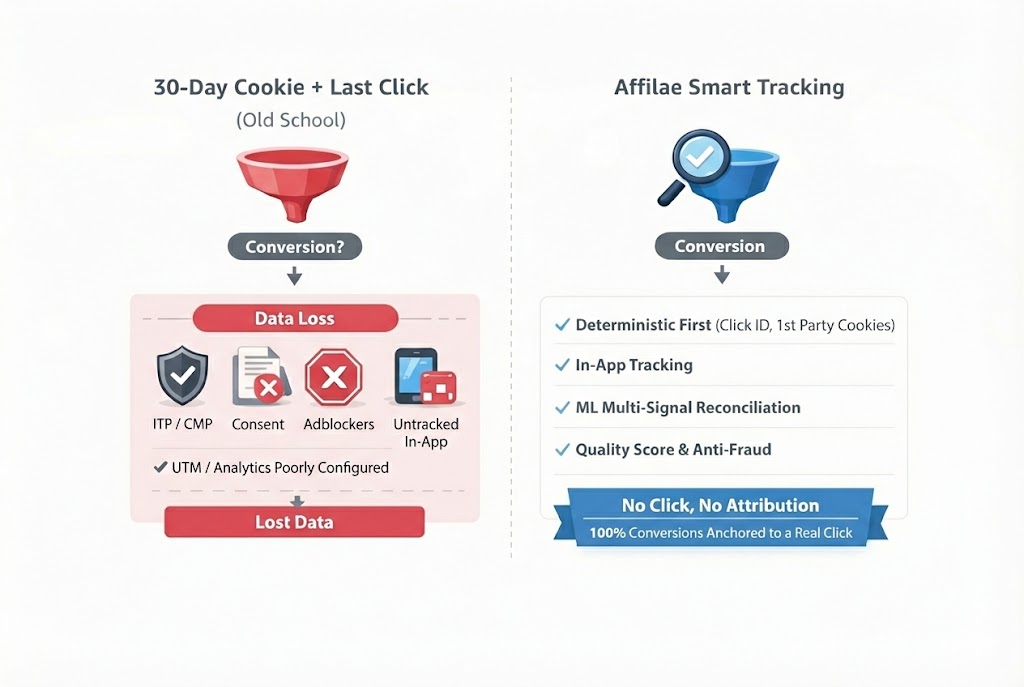
Smart Tracking: Why 30-Day Cookies + Last Click Attribution Is Outdated?
In performance marketing, one thing matters more than anything else: making the right decisions based on reliable measurement. But over the past few years, the technology and regulatory landscape has changed dramatically. Comparing results from a “deterministic 30-day cookie” model to a modern multi-signal approach often means comparing two different realities.
This focus explains, in simple terms, why “cookie + last click” tracking has become incomplete, and how Affilae’s Smart Tracking helps restore more consistent measurement without ever “inflating” performance.
1) The real issue: structural measurement loss
For a long time, tracking was fairly linear:
click → cookie → attributed conversion
Today, that chain breaks more often because constraints have become structural:
cookie blocking and anti-tracking mechanisms (browsers, CMPs),
iOS / Android restrictions,
ad blockers preventing pixels from firing,
consent requirements (GDPR / CNIL) reducing observable coverage,
losses caused by incorrect or inconsistent UTM / analytics configurations.
This is the key point: when the “click → conversion” chain breaks, the conversion can still be real, but it becomes orphaned from an attribution perspective. And this is not just a reporting issue: it can lead to under-payment of publishers/creators and biased budget decisions.
Another major blind spot: in-app conversions
A growing share of journeys now end directly inside mobile apps (e-commerce, retail, services), where web cookies and pixels are not enough to reliably connect the initial click to the conversion. Without robust in-app tracking, part of the performance becomes invisible, and therefore potentially under-attributed and under-paid.
A concrete example: on La Redoute’s mobile app, in-app tracking accounts for more than 50%* of the revenue generated by influencer activity over the analysed period (from April 1 to September 30, inclusive). In other words: if you don’t measure in-app properly, you don’t measure influencer performance properly.
* Analysis period: April 1 to September 30 (inclusive). Scope: influencer-driven revenue measured within the mobile app.
Affilae’s response: Smart Tracking
Affilae’s answer to this new reality is Smart Tracking. In practical terms, it is a multi-signal attribution method that reconciles deterministic and probabilistic approaches to keep measurement reliable in an environment that has become structurally incomplete.
It prioritises deterministic signals (Click ID, 1st-party cookies, voucher/codes, transactional identifiers) and, when the click → conversion link cannot be rebuilt deterministically, it relies on a dedicated model to reconcile the conversion with a real initial click. The goal is simple: produce attribution that is more consistent and more representative, so you can manage performance, and partner compensation, with greater accuracy.
2) Smart Tracking doesn’t “cheat” it restores a broken link
When probabilistic methods or machine learning are introduced, a common concern appears: “Does this inflate my results?”
Our answer is simple: no.
Smart Tracking does not create conversions. It corrects structural data loss by reconstructing the link between a real click and a real conversion when deterministic tracking alone is no longer sufficient.
Put plainly: we don’t manufacture performance, we prevent part of real performance from disappearing from measurement.
3) 100% of attributed conversions originate from a real initial click
This is the most important safeguard to understand:
No real initial click, no attribution.
Every conversion attributed by Affilae is anchored to a tracked click (via click identifiers and traceable signals). Smart Tracking only intervenes afterwards, to reconcile that click with the conversion when obstacles (consent, device fragmentation, blocking, etc.) prevent a direct deterministic match.
As a result, the approach is both more robust and fairer to the ecosystem, especially for affiliate partners who are not always the “last click.”
4) How Smart Tracking works (without jargon)
Smart Tracking unifies deterministic and probabilistic attribution through a very simple logic:
A) Deterministic-first: prioritise the most reliable signals
Whenever possible, attribution relies on the most trustworthy signals:
Click ID
1st-party cookies
voucher/codes
customer ID / transactional identifiers (when available and compliant)
Goal: maximise attribution that is certain, traceable, and stable.
B) Multi-signal ML reconciliation when deterministic matching is impossible
When deterministic reconciliation cannot connect the click to the conversion, a dedicated attribution model reduces the blind spot by using:
session history,
temporal and behavioural continuity,
engagement factors that improve attribution quality.
Key takeaway: this is not guesswork. It is a method designed to make measurement more representative in an environment that is inherently incomplete.
C) Quality score, anomaly detection, and fraud controls
Modern tracking must include safeguards:
quality score (confidence level / journey quality),
anomaly detection,
anti-fraud and consistency signals.
Because “simple” attribution can look clean, while still being structurally biased.
5) Why your numbers may differ from other analytics solutions?
If a solution measures primarily through deterministic 30-day cookies (often coupled with last click), it can attribute a portion of journeys very well, but it also:
mechanically loses journeys that fall outside that framework (multi-device, consent restrictions, pixel/cookie blocking),
favours end-of-journey touchpoints, because those are often the most visible.
With Smart Tracking, Affilae aims for measurement that is more consistent and more representative, by recovering part of the real conversions that become “unattributable” under an old-school model, while preserving the golden rule: no initial click, no attribution.
6) The right way to compare two tracking methods
Comparing only “total attributed conversions” is rarely meaningful. To evaluate an attribution model properly, look at:
Coverage: what share of conversions is linked to a click?
Last-click bias: who captures end-of-journey credit, and who is undervalued?
Stability: does it remain stable across devices / OS / consent scenarios?
Quality: what safeguards exist for anomalies and fraud?
Transparency: clear rules, confidence levels, auditability.
Conclusion: the challenge is no longer simplicity, it’s reliability
30-day cookies + last click had their place. But they describe modern journeys—and modern constraints, less and less accurately.
Smart Tracking is our answer: multi-signal attribution, deterministic-first, reinforced by dedicated reconciliation when needed, for measurement that is more accurate, more stable, and more representative. No tricks. No manufactured conversions. One simple principle: everything starts with a real click.
Share :